



| ||
| | |
| ||
| Explore the Rideau Canal and Friends of the Rideau by following these links:
|
 Introduction | Locking Up or Down | Evolution of the Lock | Lock Facts | About the Rideau  The use of locks, a means to raise or lower boats from one water level to another, dates back well over two thousand years. The first locks were known as flash locks. A small gate (the flash lock) was placed into a dam that had been built to raise the water level of a river for navigation. The procedure for a boat going downstream was simple, on the approach of a boat the gate was lifted and the boat would shoot through the gate at an impressive rate of speed. The procedure for going upstream was not so simple, the boat was connected to a winch or a team of horses, the gate was then opened and the boat was drawn through the gate against the powerful current. To improve on the flash lock, the Chinese, on the Grand Canal, built slipways into the dams where boats were hauled up and down by gangs of labourers. However this method led to damage of the boats and subsequent pilfering of cargo. In AD 983 a Chinese canal engineer by the name of Chhaio Wei-yo built the first chambered lock with a rising gate at either end. Boats could now enter the chamber and be lowered or lifted by just using one chamberful of water rather than the immense amount of water used with a flash lock. 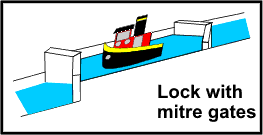 In 1485 the Duke of Milan's engineer Bertola da Novato built the Bereguardo Canal which incorporated the first modern locks. The gates were mitre shaped (perhaps based on earlier designs by Leonardo da Vinci) which caused the gates to close tightly due to the pressure of water. The mitre gate is so efficient that it is still the most common lock gate seen on the canals of the world including the Rideau Canal. In 1485 the Duke of Milan's engineer Bertola da Novato built the Bereguardo Canal which incorporated the first modern locks. The gates were mitre shaped (perhaps based on earlier designs by Leonardo da Vinci) which caused the gates to close tightly due to the pressure of water. The mitre gate is so efficient that it is still the most common lock gate seen on the canals of the world including the Rideau Canal.
 next page
Comments about the website email: webmaster@rideaufriends.com |